VEVOR elektrischer Wagenheber: how to choose the right 12 V jack
This article contains affiliate links. We may earn a commission if you buy through them.
You’ve pulled onto a flat lay-by to swap winter wheels or deal with a slow puncture. Time matters, safety matters, and the tool you reach for sets the tone. A VEVOR elektrischer Wagenheber can change this moment from wrestling a crank to a controlled, powered lift, especially when it rolls a compressor and impact wrench into one compact case.
The real question isn’t whether electricity is “better” than muscle power; it’s whether the exact lift range, capacity and 12 V setup match your car and where you’ll use it. Here’s how to check that fit, what speeds up the job in practice, and where the non-negotiable limits are.
When an electric jack is the right tool
Electric hydraulic jacks make sense when your priority is a quick, controlled lift for roadside tire work or light garage maintenance, and you can power the tool from your car. It requires level, stable ground. That’s when the core features of an integrated kit matter more than saving a kilogram of weight.
If you want a single retailer to start from, VEVOR sells a 12 V electric hydraulic jack designed for cars and SUVs within its rating, with essentials built in. The verified specs below explain what changes in real use.
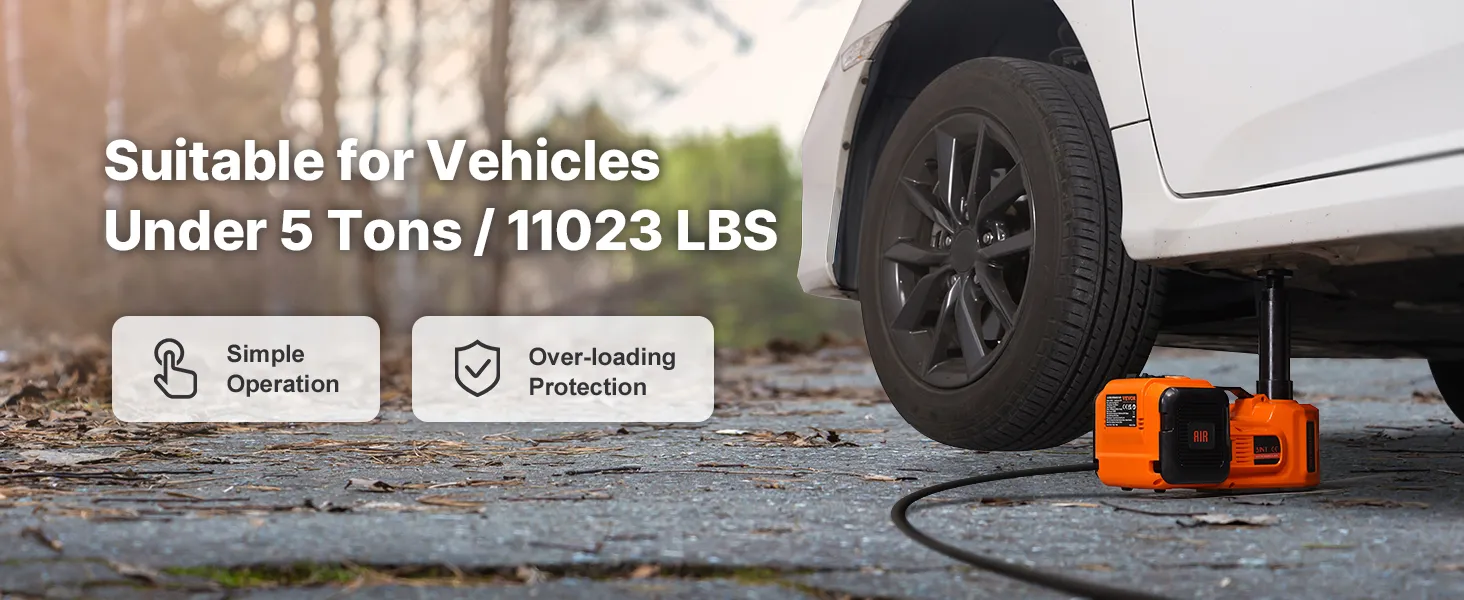
First, capacity and lift range determine fit. The jack is specified for vehicles up to 5 t within proper use, with a 155–450 mm range that reaches maximum height in roughly two minutes and auto-stop reduces over-lift risk. Pair those numbers with your vehicle’s curb weight and jacking point height now, not when you’re stranded.
Second, integrated tools simplify roadside work. VEVOR’s design bundles a tire inflator with a pressure gauge and an electric impact wrench up to 450 Nm, plus common socket sizes. In practice, that means fewer separate tools to pack and find when time is short.
Third, power and reach. You can power from 12 V outlet or battery, and the cable length (about 4.5 m) is made to reach front or rear wheels from one side. Spare fuses are included and certified—useful if you’re relying on your vehicle’s electrical system in the cold.
Tradeoffs? Electric jacks add speed and convenience, but they depend on good power and correct placement. Match lift range to your vehicle, check the ground, and treat the 5 t spec as a maximum within proper use, not a promise to lift any 5 t scenario.
Specs that matter and how to read them
Turn the spec sheet into a decision. The following criteria translate the VEVOR figures into what to measure on your car and how to judge safety.
Capacity and lift range
VEVOR elektrischer Wagenheber specs in practice begin with weight and height. The jack’s stated capacity covers vehicles under 5 t—treat this as a ceiling with proper placement at the manufacturer’s jacking points. Next, confirm the jacking point height and the extra travel you need to lift a wheel clear. The 155–450 mm range suits many cars and SUVs, but ground clearance varies. If a mid-size SUV’s jacking points sit just under 300 mm, this range typically provides headroom for wheel removal; a lowered car with very low points may need a different strategy.
Think in measurements, not labels. Measure your vehicle’s jacking point height on a level surface, then compare it to the lift range. If the numbers don’t comfortably overlap, pick another jack type from the same retailer rather than force a mismatch.
Power and speed
Power sources and speed influence how smoothly roadside jobs go. The jack can run from a 12 V cigarette lighter or connect directly to the car battery, and its cable length is intended to reach either axle without repositioning. When used properly, it takes about two minutes to reach maximum height, and it auto-stop reduces over-lift risk at the top of its travel.
What changes for you? Faster lift means less time crouched next to traffic, but only if you set up on level, stable ground and keep the power connection secure. If your 12 V socket is unreliable or fused too low, battery clamps may be the better option—check the manual and spare fuse rating ahead of time.
Tools on board
Integrated tools are the main differentiator. The built-in compressor (with a pressure gauge) lets you refill a tire without a separate pump or gauge, and storage bays keep the hose and needles organised. The included electric impact wrench is rated up to 450 Nm and ships with sleeves for 17/19 mm and 21/23 mm lugs, covering many common wheel nuts.
The practical effect: fewer items to remember and fewer steps to juggle on a hard shoulder. The tradeoff is complexity and weight compared with a simple scissor jack. If you rarely use a compressor or impact wrench, consider whether the all-in-one kit is worth carrying—or whether a simpler jack plus a separate inflator in the boot is enough for you.
450 Nm impact wrench included is meaningful if your wheel nuts are often tight or corroded; if you already keep a breaker bar in the car, the marginal benefit may be smaller.
Safety functions
Safety features are designed to make misuse less likely, not impossible. The automatic stop at maximum height reduces the chance of over-lifting, and spare TÜV/UL-certified fuses supplied protect the electrical circuit. The most important boundary is the surface itself: use the jack only on even, stable ground and follow the manual’s setup steps.
Before first use, download and read the user manual on the product page. It shows how to connect to the battery or 12 V socket, how to place the saddle at the jacking point, and the limits on slope and surface type. If your typical roadside shoulder isn’t level or firm enough, plan a different lifting method for those situations and reserve the powered jack for suitable surfaces.
Is the VEVOR elektrischer Wagenheber right for you?
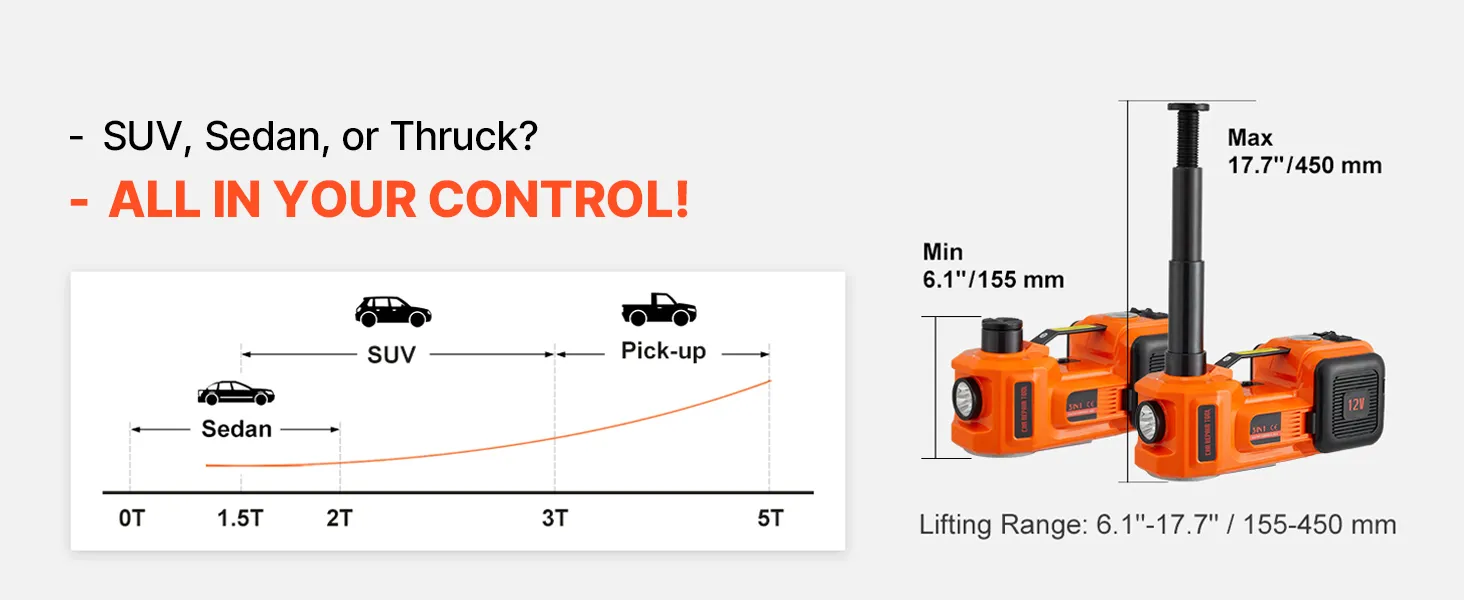
Check your curb weight and jacking points before using the listed ranges. Suppose you drive a mid‑size SUV with about 200 mm of ground clearance and jacking points under 300 mm. In that case, the 155–450 mm lift range usually covers the geometry with room to spare, and a curb weight under 5 t stays within the jack’s stated capacity. The ~2‑minute lift time, integrated inflator and included sockets can reduce the number of separate tools you need at the roadside.
Now ask what you value most. If you want fewer moving parts on a shoulder, an all‑in‑one powered kit is compelling. If your main task is rotating wheels in the garage and you want very fast up/down cycles, a pneumatic bag jack is hard to beat for throughput—especially on smooth workshop floors with air supply and space. If your priority is maximum stability and precise positioning under a low car, a hydraulic floor jack (Rangierwagenheber) remains a classic for the shop, albeit with a larger footprint and manual effort.
Ready to inspect the powered option? Visit VEVOR and look for the exact product name VEVOR Elektrischer Wagenheber 5 t, 180 W Elektrowagenheber Hydraulikzylinder 155-450 mm, Hydraulik-Handpumpe Wagenheber mit Schlagschrauber Werkzeugkasten Netzkabel für Autos SUVs. Match the lift range and rating to your vehicle, confirm the power path you’ll use, and check the manual’s ground requirements. If any of those checks don’t line up with your reality, choose a different jack type from the same retailer rather than compromise.
Roadside speed vs. shop throughput is the decisive tradeoff: the powered jack shines when you need a tidy, self‑contained kit in the car; a bag jack or floor jack can be better for repeated lifts on known, level shop surfaces.
Boundaries for safe use you shouldn’t ignore
Boundaries are part of the purchase decision. This jack is built for use on only on level, stable ground, with an automatic stop when it reaches maximum height. Treat the capacity as a maximum within proper placement at the vehicle’s jacking points; do not use it on soft shoulders, slopes, or surfaces that can crumble under load.
Powering is flexible—12 V outlet or direct battery—but verify cable reach before lifting and keep the connection protected. The fused circuit (with certified spares) helps, but it’s not a substitute for correct setup. Before your first lift, read the manual before first use from the product page, rehearse where the jacking points are on your car, and decide in advance which shoulder surfaces you will accept and which you will skip. If the surface isn’t suitable, do not lift.
Fluid transfer and overhead lifts: when to add tools
A powered jack solves wheel work. Two adjacent jobs—fuel transfer for equipment and overhead lifts in a garage—call for different tools. If they’re on your list, here’s where VEVOR has verified options and what to double‑check.
For refueling equipment or vehicles away from a station, the VEVOR Dieselpumpe, 155 W Kraftstoffpumpe Absaugpumpe, 1/4 PS Heizölpumpe 12 V 8 m Förderhöhe 3 m Saughöhe Selbstansaugend Automatik-Zapfpistole 4 m Auslassschlauch für Diesel Kerosin Transformatoröl delivers up to 37.8 L/min with about 3 m suction height and ~8 m head. It includes an auto‑shutoff nozzle, hoses and an inlet filter. Use it with diesel, kerosene or transformer oil as specified—Do not use diesel pump for gasoline—and connect to a 12 V battery for portable operation. As with the jack, download the manual on the product page before first use.
For lifting materials or parts overhead, a portable 2‑in‑1 electric hoist from VEVOR lists up to 500 kg capacity and around 30 m lift height, with wired and wireless control, a double‑hook design and an End switch adds hoist safety. These are workshop tools rather than roadside aids: confirm anchoring points, load paths and control placement, and match capacity to your heaviest anticipated lift before adding one to your kit.
Electric vs pneumatic vs floor jacks at a glance
Different jack types solve different problems. This side‑by‑side view condenses verified differences so you can validate your choice or redirect to a better fit. Match tool to vehicle and setting.
| Jack type | Capacity | Lift range | Power/operation | Notable features | Best for |
|---|---|---|---|---|---|
| Electric hydraulic jack | Up to 5 t | 155–450 mm | 12 V outlet or battery | Auto‑stop; integrated compressor; 450 Nm impact wrench | Fast roadside setup for cars/SUVs within rating |
| Pneumatic bag jack | About 5 t | ~140–470 mm | Air supply required | Very quick cycles on smooth floors | Shop throughput with space and air tools |
| Hydraulic floor jack | About 2.5 t | ~85–380 mm | Manual | Stable positioning; larger footprint | Garage work where stability is paramount |
Model‑specific dimensions and procedures still matter. Confirm the exact figures and steps on the product page and in the manual before you buy.
What to check before you buy on VEVOR
Measure once, choose once. On Shop-Ausstattung, Verify lift range and weight rating against your vehicle: jacking point height on level ground plus the clearance you need to remove a wheel, and a curb weight under the jack’s listed capacity. If those numbers align, proceed to the manual.
Check manuals and policies next. Open the downloadable user manual on the product page to confirm setup, power connections and ground requirements. For peace of mind, review the retailer’s Returns & Replacement information and any recall statements available on the site before ordering.
If fluid transfer or hoisting is also on your list, visit VEVOR to locate the diesel transfer pump and the 2‑in‑1 electric hoist pages by name, confirm fluid compatibility or anchoring and controls, and only then add them to your kit.